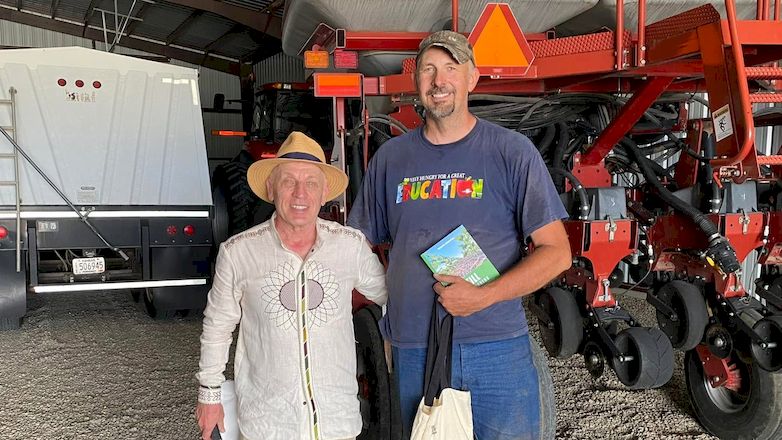
After Nebraska, our journey continued into Kansas. Our next stop was Michael Thompson’s farm.
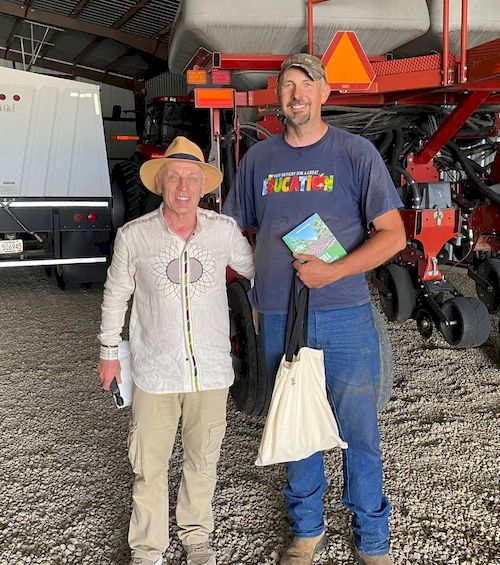 With Michael Thompson on his farm in Kansas.
I had known Michael for many years, though until then we had only met at conferences. This time, it was especially interesting to visit his farm and see how the ideas he had shared from the stage worked under real farming conditions.
From the conference stage to the farm
I first met Michael about ten years ago at the No-till on the Plains conference in the United States.
I remember recording a short Q&A video with him during one of the breaks. At the time, I could hardly have imagined that many years later I would find myself on his farm in Kansas.
Michael later became one of the speakers at our NTLAB conference. Because of the war, the event originally scheduled for February 2022 could not be held until 2023. Michael shared his experience with cover crops, integrating livestock into the farming system, and restoring soil health.
Now we had an opportunity to see all of this not just on presentation slides, but firsthand on the farm.
Different conditions
In this part of Kansas, the change in climate was immediately noticeable. It was drier than the areas we had traveled through earlier. The fields stretched across rolling, uneven terrain, and the risk of both water and wind erosion felt very real.
Under these conditions, conserving moisture and protecting the soil are not simply additional benefits. The stability of the farm largely depends on them.
Michael’s brother and father also work on the farm. The children were always nearby. Michael’s oldest son is already learning to operate farm machinery, even though he is only twelve. The younger children are also growing up surrounded by the land, livestock, and the daily work of the farm.
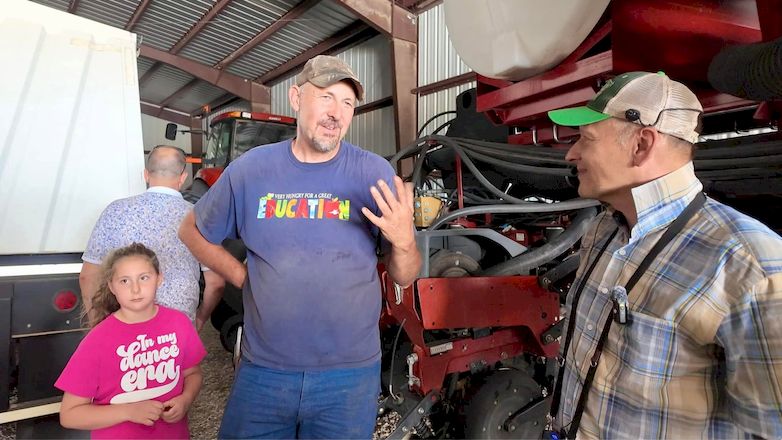 During a discussion about farm machinery. Michael’s children are always close by the adults on the farm.
It may seem like a small detail, but it says a great deal about the farm. Here, people are thinking not only about the current season, but also about who will continue working this land in the future.
No-till as part of a broader approach
Michael has long since moved beyond relying on no-till alone.
No-till remains the foundation, complemented by cover crops, livestock grazing, and greater diversity in the crop rotation. Each of these elements plays its part. Together, they help conserve moisture, protect the soil surface, and gradually restore soil health.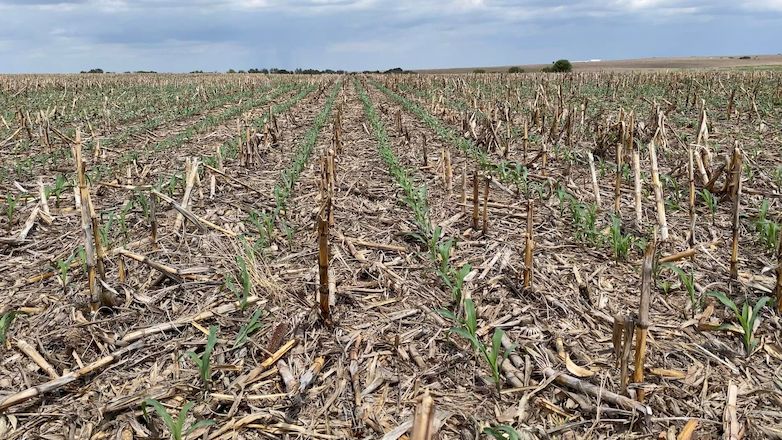 Corn in Michael Thompson’s field: the soil surface remains covered with crop residue.
One simple comparison was particularly revealing.
In one of the fields, Michael brought over a shovelful of soil from a neighboring farm that also uses no-till. We were able to compare it directly with soil from Michael’s field.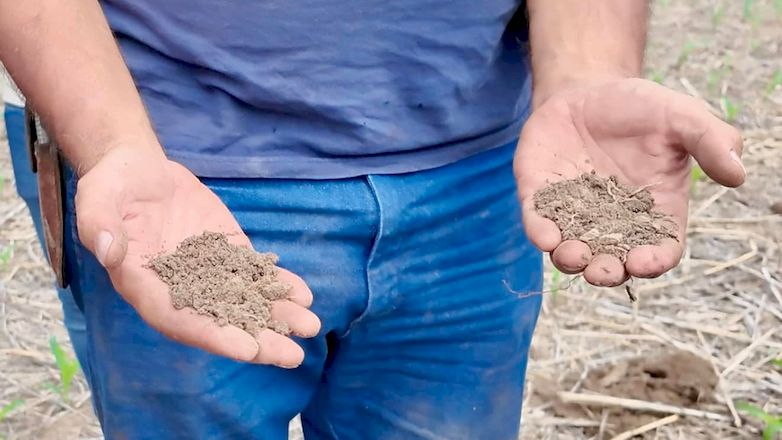 Soil samples from two neighboring farms that both use no-till.
The difference was noticeable even without laboratory tests. The soil from Michael’s field was darker and smelled completely different.
Both farms use no-till, but simply eliminating tillage does not guarantee the same results everywhere.
Seeing it firsthand
This comparison clearly showed the difference between simply giving up tillage and systematically working to improve soil health.
No-till can stop some destructive processes. But further improvement requires living roots, plant diversity, organic matter, livestock, time, and consistency. And consistency is often the first thing lost when quick results are expected.
Seeing all of this firsthand changed how I understood much of what Michael had said at conferences.
And perhaps this is what stayed with me most after the visit:
No-till can be an important first step, but healthy soil is not created simply by eliminating tillage.