
When we were told how much this combine cost, I did not immediately understand what could possibly justify a price tag of $400,000.
The machine is small. Its header is less than two meters wide, and when harvesting wheat, it covers about one acre, or 0.4 hectares, per hour. For a typical farm, it would seem like a very strange investment.
But this combine was never designed for ordinary harvest work.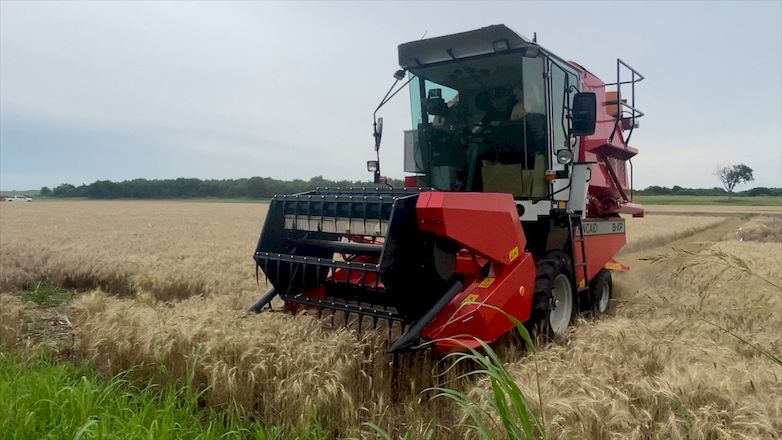
At Oklahoma State University, it is used to harvest research plots. Dr. Brian Arnall, professor of plant and soil sciences and an Extension specialist in precision nutrient management, explained how the machine is built and what it can do.
In many ways, it works like a full-sized combine. It cuts the crop, threshes it, separates the grain from the straw, and cleans it. The most interesting part comes next.
Once cleaned, the grain passes through three separate measuring chambers.
The first weighs the grain harvested from each research plot. The second measures its moisture content. The third measures its test weight.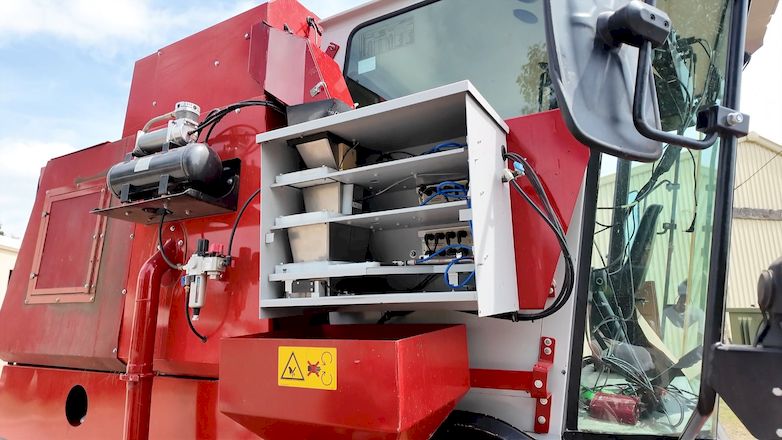
In other words, the combine performs directly in the field some of the work that would normally be done in a laboratory after harvest. A separate grain sample is also collected for a full laboratory analysis, while the rest goes into the grain tank.
Each small plot in a trial may differ in fertilizer rate, variety, management practice, or some other treatment. Simply harvesting the grain is not enough. Researchers need to know exactly which result came from each individual treatment.
That is why such a complex measuring system is needed. The system alone costs about $80,000, while the entire combine is worth approximately $400,000.
Harvesting capacity takes a back seat here. The machine’s job is not to move quickly across a large field. It must carefully harvest many small plots without losing the data the trial was designed to produce.
But it was not only the combine itself that surprised me.
It was interesting to see that a university could invest so much money in equipment for field research. This is not a display piece or a machine reserved for demonstrations. It is a working research tool.
Brian Arnall explained that much of his work focuses on practical solutions that can be put into practice on farms within two or three years. At the same time, the university also conducts long-term trials designed to produce meaningful results only after twenty years.
Perhaps that changes how the price is perceived more than anything else.
If the combine is judged only by the number of hectares it harvests, $400,000 seems like an incredible amount. But here, the machine collects more than grain. Every pass also produces accurate data that can be used to compare different treatments and management decisions.
In this kind of work, one hectare can sometimes provide more information than hundreds of hectares of an ordinary field.