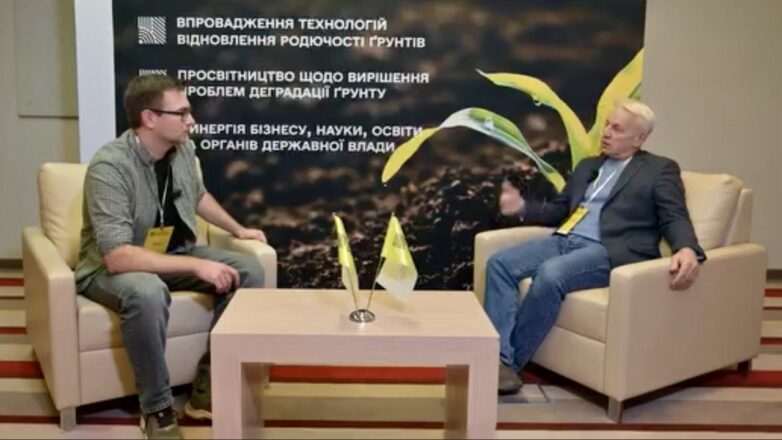
 In a brief interview for the BTU Soil Health platform, I was asked what motivates farmers to switch to no-till, whether it is still relevant in Ukraine, and what determines whether it succeeds on a particular farm.
The conversation lasted about 10 minutes. But sometimes a short format leaves little room for anything but the essentials.
Farmers often turn to no-till for economic reasons. We have little influence over the prices at which we sell our crops or the prices we pay for inputs. But we can reduce production costs.
Another important reason is the need to stop water or wind erosion. Once these initial challenges are addressed, attention gradually shifts to the soil itself. Halting degradation and stabilizing its condition is the minimum. The larger goal is to improve the soil and its fertility.
My own path to no-till began with wind erosion in Crimea. At first, I stopped plowing and switched to minimum tillage. But the loosened topsoil was still easily blown away by the wind.
I did not embrace no-till immediately. It seemed to me that the Crimean soil was too hard and that this approach would not work for us. I became interested only after seeing it firsthand in the fields of other farms.
Ultimately, no-till helped us improve both our economics and our control of erosion. Even if it had given us nothing except soil protection, I would still say it was worth adopting.
At the same time, I would not associate no-till only with southern regions or a particular amount of rainfall. Farmers have different reasons for changing their approach under different soil and climatic conditions. Where rainfall is scarce, moisture conservation becomes the main incentive. In regions with more rainfall, farmers may adopt no-till because they want to improve their soil, grow cover crops, or preserve the improvements they have already achieved.
Success is not determined by farm size either. Both small farms and large agricultural companies provide examples of success and failure. What matters is whether the people making the decisions understand why they are switching to no-till and what problem they want to solve.
Changing equipment is not that difficult. A farm can buy a seeder or a particular input. Changing the way people think is much harder.
No-till does not start with buying a seeder. It starts with understanding why the farm needs to change.