Under one of my posts, a reader asked why, amid the war and the rising cost of virtually every input, Ukrainian agricultural science and the government show so little interest in practices that help preserve the soil while reducing production costs.
The question stayed with me because I don’t have a ready answer.
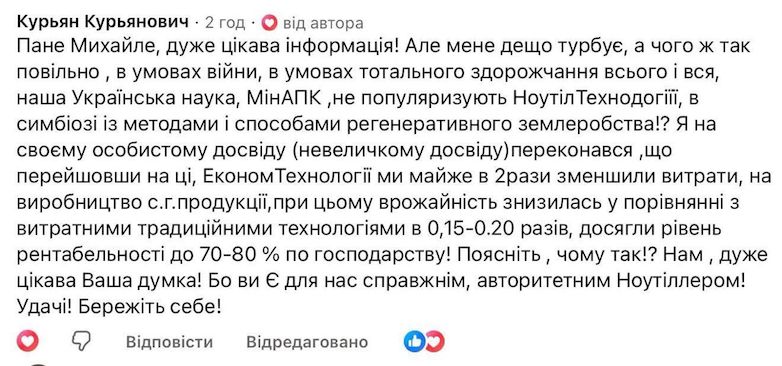
Why, at a time when the war continues and resources are becoming more expensive, is there so little interest in approaches that can protect the soil and reduce farmers’ costs?
Honestly, I find it difficult to understand.
We constantly hear about the degradation of Ukrainian soils, erosion, declining organic matter, and moisture shortages. But where are the long-term studies of farms that have operated without tillage for years, use cover crops, and maintain diverse crop rotations?
Such research should not be limited to comparing yields from a single plot in a single season.
It should also examine the entire farm economy: fuel use, machinery costs, fertilizers, crop protection products, and working hours. It should measure water infiltration, erosion, changes in soil organic matter, and the activity of soil organisms.
And it should look not at one crop, but at the entire crop rotation. Not only in a favorable season, but also when drought arrives.
Perhaps the complexity of this kind of research makes it easier for the government and research institutions to continue supporting familiar technological solutions. But that may be an explanation. It is not an excuse.
With the war continuing, input prices rising, and soil conditions deteriorating, this work should be a priority.
I don’t want to suggest that Ukrainian agricultural science is doing nothing. There are individual researchers and individual studies. Perhaps there is a significant amount of work that I simply haven’t come across.
Still, I don’t yet see a systematic interest in the practical experience of farms already using these approaches.
Meanwhile, farmers are conducting their own experiments across hundreds or even thousands of hectares, at their own expense and at their own risk. Some achieve good results. Others make mistakes.
This is precisely where science could be especially valuable: testing, measuring, distinguishing consistent patterns from chance results, and explaining where a particular approach works and where it does not.

I am not calling on the Ministry to make no-till mandatory for everyone. That would be just as misguided as imposing any single technology on every farm. Soils, climates, and farmers’ resources and capabilities differ.
But between mandatory adoption and an almost complete lack of attention, there is a great deal of room for objective research.
Perhaps some of the readers are scientists working in this field. I would be grateful for links to long-term Ukrainian studies of no-till and other regenerative practices, especially studies that evaluate not only yields but also economic performance, moisture, and changes in the soil.
I would genuinely like to understand: am I simply not seeing this work, or does very little of it exist so far?