By the time we arrived at the Oklahoma State University research fields, the wheat had already been harvested.
“Sorry, we didn’t wait for you. We harvested it last week,” Brian Arnall joked.
All that remained was stubble. At first glance, it looked like an ordinary field, one of thousands. But winter wheat has been grown continuously on this same ground since 1892.

These are the Magruder Plots, one of the world’s oldest continuous wheat experiments. Wheat has now been grown here without crop rotation for 134 years.
The original purpose of the experiment was to find out what would happen to yields and soil if wheat were grown year after year on plowed native prairie without any fertilizer inputs.
Different fertility treatments were added later. Manure was applied to part of the field, while a neighboring control plot continued to receive no fertilizer. As commercial fertilizers became widely available, treatments using mineral fertilizers were added, followed later by a treatment that also included lime.
Wheat Without Fertilizer
We began with a plot that has received no fertilizer for more than a century.
Wheat still grows here and yields around one metric ton per hectare. However, much of the fertility inherited from the native prairie has already been depleted. According to Oklahoma State University, soil organic matter in the surface layer declined from about 4% at the beginning of the experiment to approximately 1%.
But something interesting happened.
Researchers found a much greater abundance of nitrogen-fixing microorganisms in this plot than in the manure and NPK treatments. Where no nitrogen was supplied from outside, the soil microbial community adapted to its scarcity.
Of course, this does not mean that the soil became capable of supplying all the nitrogen the wheat needed. The yield shows the limits of that adaptation. Still, the soil did not remain passive. Over the decades, a different microbial community developed there.
Manure and Commercial Fertilizer
The manure treatment has more soil organic matter, higher yields and a more diverse microbial community.
However, the amount of manure applied cannot be increased without limit. The application rate is calculated according to the crop’s nitrogen needs, but manure also adds phosphorus. When soil phosphorus approaches the established environmental threshold, the manure rate must be reduced.
The neighboring plots receive commercial NPK fertilizer. One treatment receives NPK alone, while another also receives lime whenever soil pH falls below the prescribed level.
The difference between these two treatments clearly demonstrates one consequence of long-term fertilizer use. In the plot that received NPK without lime for many years, surface soil pH fell to around 4.5. Where lime was used to control acidity, soil pH remained at a much more suitable level.
So it is not only the type of fertilizer that matters. It also matters how long it is used and whether the resulting changes in the soil are monitored.
An Unexpected Result
What surprised me most was Brian’s explanation of what happened to soil organic matter.
In the treatment receiving a complete commercial fertilizer program, soil organic matter increased faster than in the manure treatment. At first, this seems to contradict the usual logic: surely an organic fertilizer should build soil organic matter more quickly.
Brian explained that the difference was related to yield. Commercial fertilizer supplied nutrients more consistently, allowing the wheat to produce more biomass. As a result, more crop residue was returned to the soil after harvest.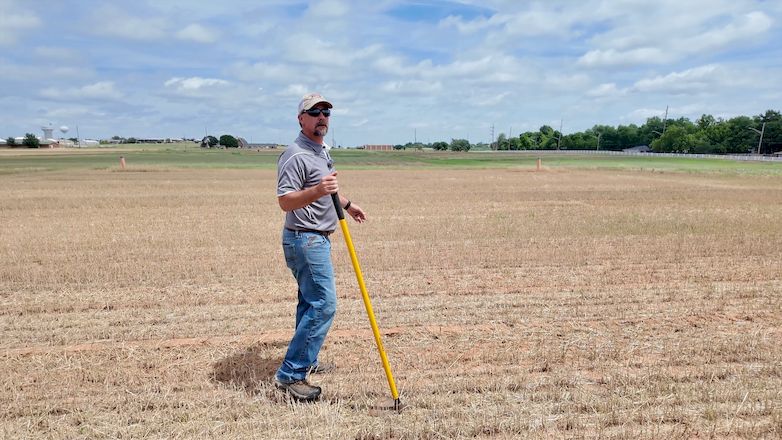
This does not mean that commercial fertilizer is better than manure. The manure treatment, for example, supported a more diverse microbial community. In the commercially fertilized plot, the microbial community was different and more closely adapted to wheat.
There is no simple winner in this experiment. It shows how a fertility source can trigger an entire chain of changes, affecting yield, crop residue production, soil organic matter, acidity and the composition of the soil microbial community.
An Important Context
Wheat in the Magruder Plots is grown continuously under conventional tillage, with the straw incorporated into the surface soil.
The results of this experiment, therefore, should not be transferred automatically to no-till, diverse crop rotations or cover crop systems. For decades, the primary variable here has been fertility management, while the researchers have tried to keep the other conditions as consistent as possible.
At the same time, the university conducts other long-term experiments nearby involving no-till, different crop rotations and soils with different initial organic matter levels. Brian explained that researchers also compare data from these plots to understand how the soil is affected not only by fertility management, but by the entire farming system.
However, these are separate experiments with different histories and conditions. The value of the Magruder Plots lies in their consistent approach over 134 years: continuous wheat, consistent tillage and different fertility treatments.
A single growing season can support almost any idea we already hold. One year is wet, another is dry. Varieties, weather and yields change. Sometimes we see a result we like and are too quick to call it a pattern.
In this field, the soil has had 134 years to respond.
And its response has turned out to be more complex than a simple choice between organic and commercial fertilizers.