Corn needs sulfur. That much is well known. But the crop’s need for a particular nutrient does not automatically tell us whether applying it will increase yield in a specific field.
On one of the research plots, Oklahoma State University professor Brian Arnall showed us just how complicated this relationship can be. Oklahoma State University professor Brian Arnall discusses corn fertility research with a Ukrainian group.
Only 12 fields out of 36
Last year, Brian launched a multi-state research program examining sulfur use in corn, with trial sites stretching from Mississippi to Michigan. This year, the program expanded to Canada and Brazil.
One of its main goals is to understand how additional sulfur affects nitrogen uptake by corn.
The first year produced mixed results. Of the 36 fields included in the study, only 12 responded positively to sulfur application. That is just one-third.
That number left me somewhat puzzled. We have been hearing more and more about the importance of sulfur in corn production. Yet even when the crop needs sulfur, applying more of it does not necessarily result in a yield increase.
Many of the fields in the study showed no response to sulfur at all. At other sites, the outcome changed depending on the nitrogen rate.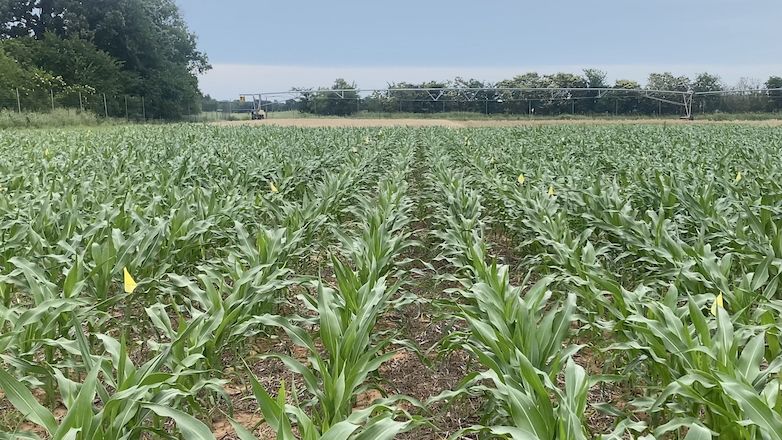 A corn research plot where plant responses to different fertility treatments are being compared.
Sulfur does not work separately from nitrogen
The usual logic seems straightforward. When sulfur is deficient, the plant cannot use nitrogen efficiently. Therefore, adding sulfur should improve nitrogen-use efficiency.
But the research suggests that this relationship can work in the opposite direction as well.
If nitrogen availability is low and too much sulfur is applied, the result can also be negative. Excess nitrogen, in turn, may interfere with sulfate uptake by the plant. The issue, then, is not simply a shortage of one nutrient but the balance between the two.
Researchers observed very different responses among sites. In some cases, sulfur increased yield at a lower nitrogen rate but provided no benefit after the nitrogen rate was raised. At other sites, the response to sulfur appeared only with higher nitrogen rates. Some fields showed little response to changes in nitrogen rate at all.
This variability is exactly what Brian is trying to explain.
 Corn response to sulfur varied with nitrogen rate and site-specific conditions.
The 10:1 ratio
During our conversation, a familiar ratio came up: approximately ten parts nitrogen to one part sulfur.
Brian described a 10:1 ratio as a safe starting point. However, one purpose of the current research program is to identify the conditions under which that ratio shifts significantly in either direction.
After all, fertilizer is not the crop’s only source of sulfur. Some sulfur becomes available from the soil through the mineralization of organic matter. How much the soil supplies depends on its properties and the rate of mineralization.
That is why simple arithmetic may fail when the crop’s total sulfur requirement is immediately converted into a fertilizer rate. First, we need to understand how much of that requirement the soil is already supplying.
What about zinc?
On this research plot, the situation with zinc is different. According to Brian, the local soils contain enough zinc, so at moderate yield levels the recommendation for additional zinc may be zero.
With a higher yield goal, he may consider applying a small amount of zinc as insurance. But this is not an automatic part of the fertility program. It is a field-specific decision.
Brian is also cautious about foliar zinc. It is more expensive and less effective than supplying zinc through the soil. He mainly uses foliar applications to help corn recover from stress.
According to him, a serious zinc deficiency cannot be fully corrected with a foliar application.
The field does its own math
We often consider each nutrient separately: how much nitrogen, sulfur or zinc should be applied? That approach makes calculations easier. But the plant receives all these nutrients at the same time, and the outcome depends on how they interact.
Perhaps that is why the question “How much sulfur should we apply?” is incomplete on its own. First, we need to understand the nitrogen rate it will be working with and how much sulfur the soil can supply.
The same applies to zinc. The fact that a nutrient appears in a general recommendation does not mean it is required in every field or every season.
The arithmetic may look correct. But the field still does its own math.