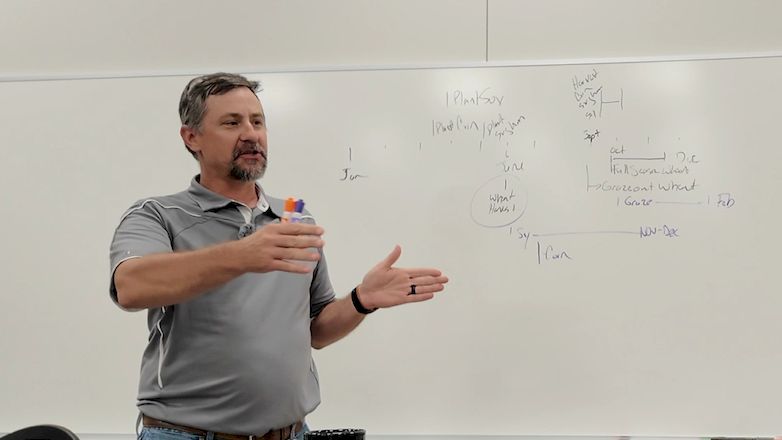
In Oklahoma, farmers do not necessarily have to make the final decision at planting.
Winter wheat is often grown here for two purposes. Cattle graze it from fall through late winter. Then, in spring, the farmer decides whether to remove the cattle before the growing point rises above the soil surface and allow the wheat to produce grain, or to continue grazing it.
What determines this choice?
The expected price of wheat and the profitability of livestock production are major factors. But there is more to consider. The yield potential of the particular field also matters. If a field is capable of producing a very high grain yield, it may not be grazed at all.
Brian Arnall, a professor at Oklahoma State University and a precision nutrient management specialist, drew this system on the whiteboard during our meeting.

What interested me was not only the opportunity to use the same field for both grazing and grain production. Perhaps even more interesting was the flexibility it gives the farmer. There is no need to commit to one scenario from the beginning. The final decision can be made later, when the condition of the crop, its yield potential, and the market outlook are clearer.
In the video, we also discuss winter wheat planting dates and fertility management, double-crop soybeans and corn, and why some early nitrogen stress may actually benefit the crop.
Watch the full conversation with Brian Arnall in the video below.