A three-person team manages more than 1,600 hectares, or about 4,000 acres, on Justin Regehr’s family farm in Kansas.
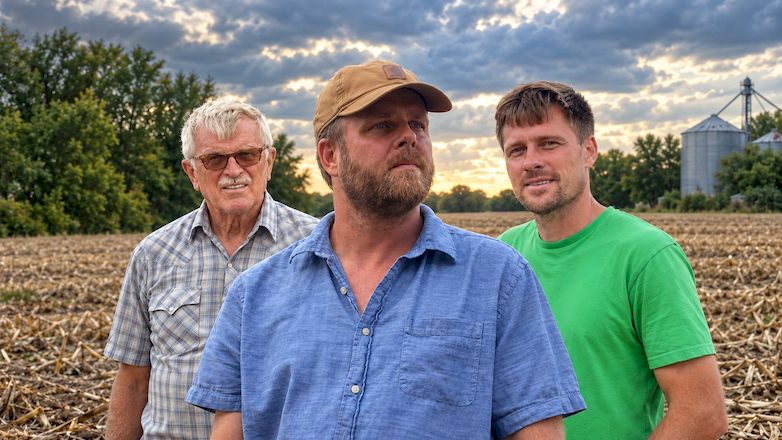 Justin Regehr, his father and his brother. This collage was created from photographs taken during our visit to the family farm in Kansas.
Justin and his brother are the sixth generation of farmers in the Regehr family. There is also a detail in their family history that feels especially close to us: their ancestors moved to Kansas from the Odesa region in the 1870s.
About one-quarter of the farm is irrigated, while the rest is dryland. The family grows corn, soybeans, wheat, grain sorghum and sunflowers. Sunflowers are often planted as a double crop after wheat, allowing five crops to fit into a four-year rotation.
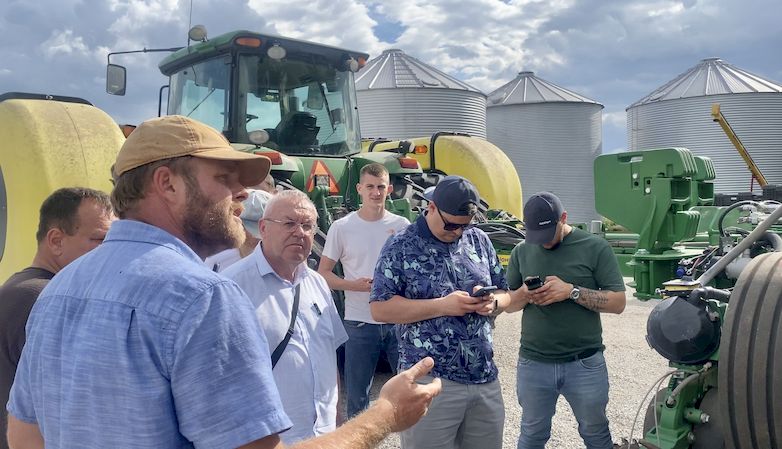 Justin Regehr shows a group of Ukrainian farmers the machinery used on his farm.
No-till has been the foundation of the farming system for 15 years. Cover crops were added about 10 years ago. Cereal rye is commonly planted ahead of soybeans, while summer cover crop mixes following wheat may include sorghum-sudangrass, sunflowers, sunn hemp and cowpeas. Some of the wheat and cover crops are also grazed by cattle.
There is one exception to the no-till system. Strip-till is used on part of the irrigated corn acres to apply anhydrous ammonia. Justin describes it as the farm’s only tillage operation.
When Justin was asked about the biggest change they had seen after introducing cover crops, he did not talk about record yields. His answer was much simpler: the soil began holding moisture longer.
In Kansas, where the outcome on dryland acres depends heavily on rainfall, that may be the most important change of all.
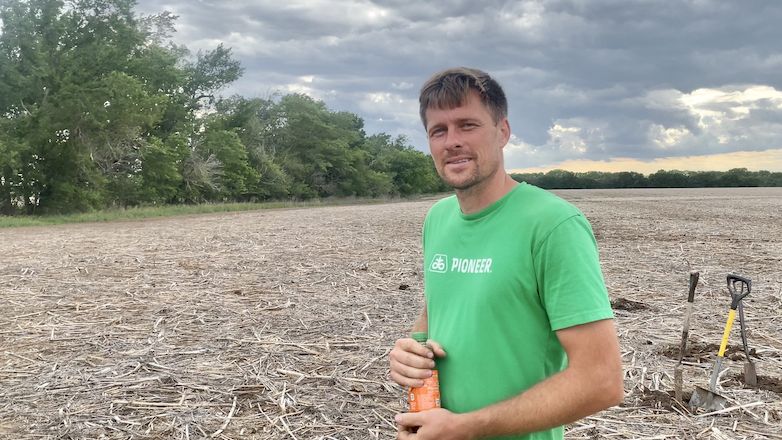
Justin’s brother in one of the family farm’s fields.
Justin’s answer to another question was even more interesting: Which decision made during the past five years had been the most effective?
He pointed to the shift from a conventional starter fertilizer to a biological product prepared directly on the farm. It is made using vermicompost and soil collected from undisturbed areas that had never been tilled or treated with chemicals.
The resulting extract is applied at planting across different crops. Justin emphasizes that they do not view it as a fertilizer. They see it more as an inoculant intended to stimulate biological processes in the soil.
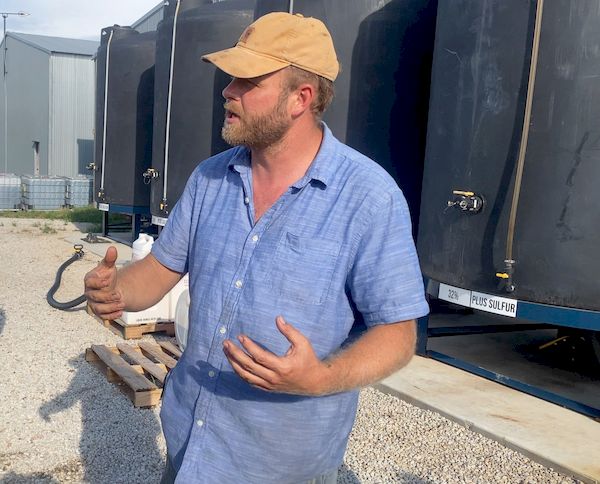 Justin explains the farm’s crop fertility program.
The benefits become most apparent during stressful seasons. The plants cope better with drought, and yields become more stable. Justin considers this improved stress tolerance to be the main advantage of their biological starter.
At first, the number itself is what stands out: more than 1,600 hectares managed by only three people. But there is more behind that number than large machinery and well-organized work.
This is the story of six generations of one farming family, a gradual transition to no-till and cover crops, the integration of grazing, and an effort to shift more of the work back to biological processes in the soil.
Watch the new No-Tiller video to learn more about Justin Regehr’s crop rotation, fertility program, use of vermicompost and the way his family organizes work on the farm.