As we drove through Illinois and later Iowa, I began noticing green strips in the fields along the way. They wound between the crops, followed natural depressions, and in some places crossed almost the entire field.
These were not boundaries between fields. It was clear that farmers had intentionally seeded these areas with perennial grasses rather than planting corn or soybeans there.
This is where runoff collects during heavy rains. If the soil is left unprotected, flowing water gradually washes it away, and rills and gullies can form in the field.
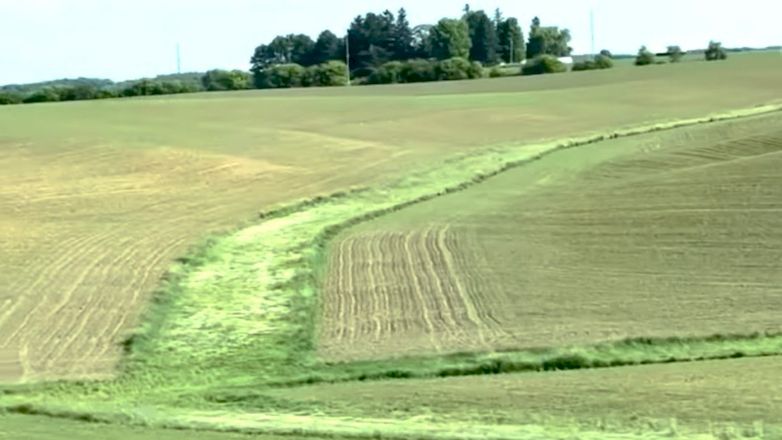
A grassed waterway instead of a gully
These strips are known as grassed waterways.
Water still follows the natural depression. But instead of flowing over bare soil, it passes through a strip protected by grass and dense sod. The grass slows the flow, holds the soil in place, and prevents the water from making gullies deeper and wider.
In one such area, the grass had been mowed. This means the land does not necessarily lose all its value to the farm: the grass can be used as forage. The main crop, however, is no longer grown there.
The farmer deliberately takes part of the field out of production to protect a much larger area.
What a farmer from Iowa explained
Later, during a conversation with a farmer in Iowa, we asked him about these grass strips.
He confirmed that they allow water to leave the field safely and protect the soil from erosion. Farmers can receive government payments for taking such areas out of production.
According to his estimate, in their area these strips account for no more than one percent of farm acreage. Payments range from $200 to $300 per acre, depending on the land.
As he explained, the payments do not apply to the natural watercourse itself, but to the strip alongside it.
I was curious about something else. I asked whether they would keep these strips if the government stopped making the payments.
The farmer said they would. They had already seen the benefits of grassed waterways and would not return these areas to crop production even without government support.
Not every square meter needs to be planted
Perhaps his answer best explains how farmers view these areas.
The government program compensates farmers for land that is not used to grow the main crop. Over time, however, they also see the direct benefit to the farm: water no longer cuts through the field or deepens gullies, and the fertile topsoil stays in place.
Farmers usually try to make use of every available hectare. This is understandable. Land needs to generate income. But sometimes trying to plant every square meter leads to greater losses.
Grassed waterways offer a different approach. A small part of the field is kept under perennial grass to protect the rest of it.
I believe our farmers should adopt this practice as well, especially in places where water repeatedly follows the same path after heavy rains, gradually making gullies deeper and wider.
Sometimes the best way to earn money from the land is not to plant every square meter. A small strip of grass can protect far more soil around it.