I first visited Green Cover Seed in 2017. Since then, Keith Berns and I have met many times at conferences, and in 2021 he was one of the speakers at NTLAB21.
I especially remember the summer of 2022, when we hosted the “Agrarian Front” live broadcasts. Keith agreed to take part without hesitation. Together with other American farmers and specialists, he shared his experience and supported Ukrainian farmers during what was perhaps the most difficult period for us.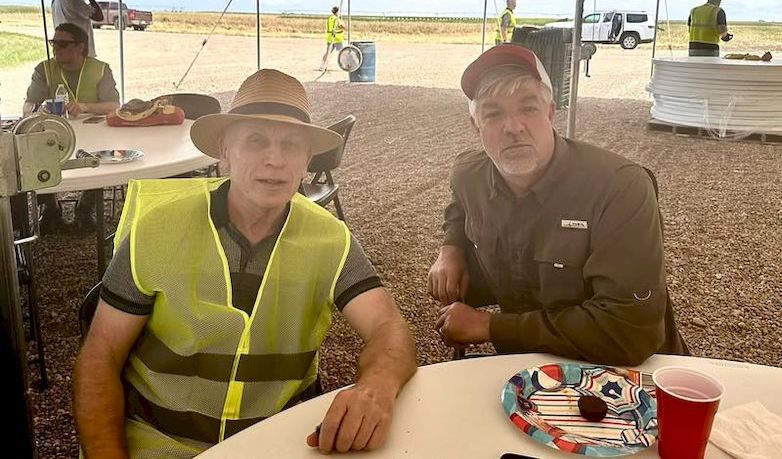 With Keith Berns during our latest meeting at Green Cover Seed.
That is why meeting him again in Nebraska was more than just another stop on our agricultural tour.
Keith showed us the Green Cover Seed production facility, where cover crop seed mixes are prepared for farmers. He also told us how two brothers’ search for solutions for their own farm gradually developed into one of the best-known cover crop companies in the United States.
It was good to see that, after all these years, Keith remains just as open to conversation and willing to share his practical experience.
Don’t start with the mix
During our walk through Green Cover Seed’s demonstration plots, Keith was asked many questions about cover crops.
One thing about his answers caught my attention: he almost never recommended a ready-made mix.
Instead of listing species and seeding rates, Keith kept returning to the same question:
What problem are you trying to solve?
In his view, this is exactly where the selection of cover crops should begin.
For one farm, the main objective may be to protect the soil from erosion. For another, it may be to conserve moisture, fix nitrogen, improve soil structure, provide livestock forage, or suppress weeds.
The choice of plants depends on that objective. The same mix cannot work equally well under different conditions or serve completely different purposes.
So the first question should not be, “Which mix should I plant?” It should be, “What exactly do I want to change in this field?”
Don’t look for a perfect recipe
Keith’s next piece of advice was not to search for the “perfect” mix.
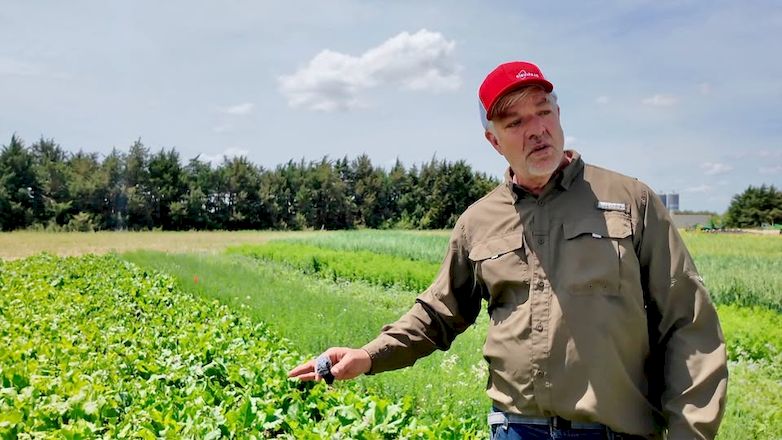 Keith Berns at the Green Cover Seed demonstration plots in Nebraska.
Instead, he recommended experimenting continuously: sowing different options side by side, observing how the plants develop, watching what happens to the soil, and comparing the results under your own conditions.
This matters because cover crops do not function separately from the rest of the farming system. The outcome depends on the climate, soil, rainfall, crop rotation, sowing dates, available equipment, and how the cover crops will be managed or used.
What works well on one farm may produce very different results in a neighboring field.
The demonstration plots at Green Cover Seed illustrate this approach clearly. Here, farmers can see individual plant species as well as different combinations of them. In a living field, it is much easier to understand how each plant develops, what role it plays in a mix, and what function it can perform.
But a demonstration plot does not give farmers a ready-made formula. It helps them understand the plants better so that they can test different options in their own fields.
What do you want to maximize?
Another thought from Keith that stayed with me concerned how we evaluate results.
Before deciding whether a mix has worked, he suggested answering one simple question:
What do you want to maximize: yield or profitability?
These are not always the same thing.
A farmer may achieve a higher yield but spend so much to obtain it that the farm’s profit barely changes. Or the yield may be slightly lower, while costs are reduced, more moisture is retained, the soil is better protected, and the economic result becomes more stable.
The answer to this question also influences which cover crops should be used and what role they are expected to play in the farming system.
If cover crops are evaluated only by the yield of the following cash crop, other benefits may be overlooked: less erosion, more organic matter, better water infiltration, additional livestock forage, or lower production costs.
So even before sowing, it is important to define not only the objective but also the criteria by which the result will later be evaluated.
The mix as part of the system
Keith’s approach does not offer a universal recipe that can simply be transferred from one farm to another.
The sequence is different: define the objective, select plants that can help achieve it, test several options, observe what happens, and evaluate the results using criteria established in advance.
Perhaps this is also why Green Cover did not begin as an abstract business idea. Keith and his brother were farmers looking for solutions for their own land. When they could not find the mixes they needed on the market, they began developing and testing their own.
Over time, that practical search grew into a separate business. But at its core remained the same farmer’s question:
What problem do we want to solve in this field?
Cover crops do not begin with a list of seeds. They begin with an understanding of why the farm needs the mix and how it should work within the wider farming system.