At first glance, the logic seems simple. Soil biology needs carbon. So, if we give it an easily available source of energy, such as molasses or ordinary sugar, microorganisms should become more active and begin working more effectively for soil fertility.
This is the idea being tested on research plots at Oklahoma State University. Professor Brian Arnall explained the experiment to us.
Sugar in a wheat trial
On these research plots, molasses and ordinary table sugar are applied to wheat. The researchers compare different rates, application timings and methods.
The idea is to provide soil microorganisms with readily available carbon and stimulate their activity.
The practice itself is not new. Sugar and molasses are already used on some farms, particularly by farmers who pay close attention to soil biology. The explanation is often quite simple: we feed the microorganisms, and they, in turn, help the plants.
But Brian’s explanation made me look at this practice a little differently.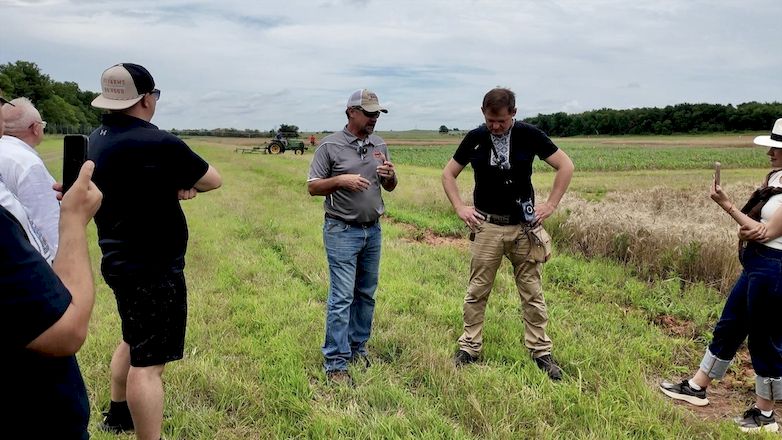
What happens to nitrogen?
When we add carbon, we are not simply “feeding the biology.” We are also changing the carbon-to-nitrogen ratio in the soil.
Once microorganisms receive an easily available source of carbon, they begin multiplying rapidly. But they need more than carbon to do that. They also need nitrogen. As a result, they may begin immobilizing available nitrogen faster than the crop can use it.
So biological activity may increase without necessarily benefiting the crop. In fact, the plants may experience greater nitrogen deficiency.
Brian is particularly cautious about applying sugar to soils with relatively low organic matter levels. Based on his practical experience, the risk becomes greater when soil organic matter is below approximately 2.5%.
This is not a universal threshold or a ready-made prescription for every field. But according to Brian, attempting to stimulate soil biology under these conditions may intensify an existing nitrogen shortage.
The application method also matters. Applying sugar in a concentrated band near the row creates very different conditions from spraying a diluted solution across the entire soil surface. With a broadcast application, the microbial response may occur across a much larger area, increasing the overall demand for nitrogen.

More biology does not always mean a better result
Brian also raised another concern.
After receiving a readily available source of carbon, the microbial population may increase rapidly. But the sugar is soon consumed. Some of that expanded population then dies, the system changes again, and the nitrogen held in microbial biomass does not necessarily become immediately available to the crop.
In other words, greater biological activity alone tells us very little about the final outcome.
Interestingly, Professor Brian Arnall cited the example of a farmer who lost 2% soil organic matter over ten years of using sugars.
This was not a result from the university experiment. It was an individual case from farming practice that Brian had observed. It would therefore be wrong to use it as evidence that applying sugar is always harmful.
Still, the example is difficult to ignore. The farmer used sugars with the intention of supporting soil biology and building organic matter, yet the result was the opposite.
Perhaps stimulating the microorganisms accelerated not only the formation of new organic matter but also the decomposition of organic matter already present in the soil. Without the field’s complete history, it is impossible to know for certain. Even so, the outcome deserves attention.
Neither fertilizer nor poison
This experiment does not yet give us grounds to conclude that applying sugar is always beneficial or always harmful.
The result depends on the soil’s initial condition, its organic matter content, nitrogen availability, application rate, timing and placement. The same practice can trigger very different processes under different conditions.
For me, the most interesting question is not simply whether sugar should be applied. Understanding the mechanism is far more important.
The phrase “feeding soil biology” sounds attractive. Perhaps a little too attractive. It creates the impression that all we need to do is add a carbon source and allow the microorganisms to take care of everything else.
But soil biology does not exist separately from plants, nitrogen, moisture or the organic matter already present in the soil. When we stimulate one part of the system, we inevitably affect the others.
Before adding anything, we should understand not only what we want to feed the microorganisms, but also what they are likely to do afterward.