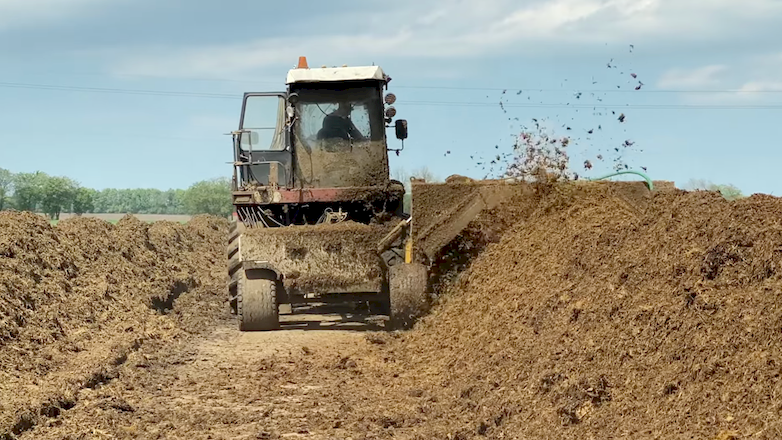
During our visit to Butenko Farm in the Chernihiv region, we toured the farm, looked at the machinery, visited the composting site, and walked through several fields. What stayed with me most, however, were the plots with difficult sandy soils.
Roman Butenko showed us land where almost nothing used to grow. These sandy soils retain little moisture and contain little organic matter, making it much harder to create favorable conditions for plants. Under such circumstances, no single farming practice is likely to deliver quick results.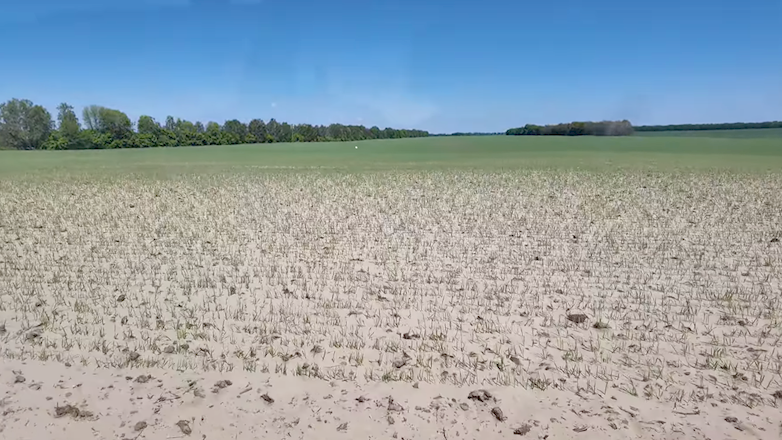
The farm decided to gradually return organic matter to these plots in the form of compost. This is not about applying it once and waiting for a miracle. It is about creating, step by step, the conditions in which the soil can begin to recover.
In some places, the first changes are already visible. Plants are gradually beginning to grow where almost nothing grew before. This is not the final result, nor is it a story about turning sand into fertile soil overnight. But the land is already beginning to respond to the return of organic matter.
After inspecting the fields, we visited the composting site. Roman explained how the farm prepares compost, how the compost turner works, and how the material is formed into windrows.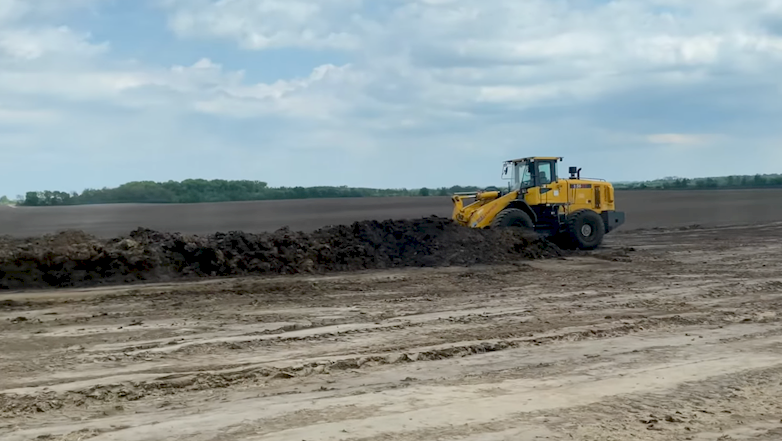
But the main point is not the equipment used to mix and aerate the compost. It is the approach itself: making use of the organic matter the farm already has and returning it to the fields rather than letting it go to waste.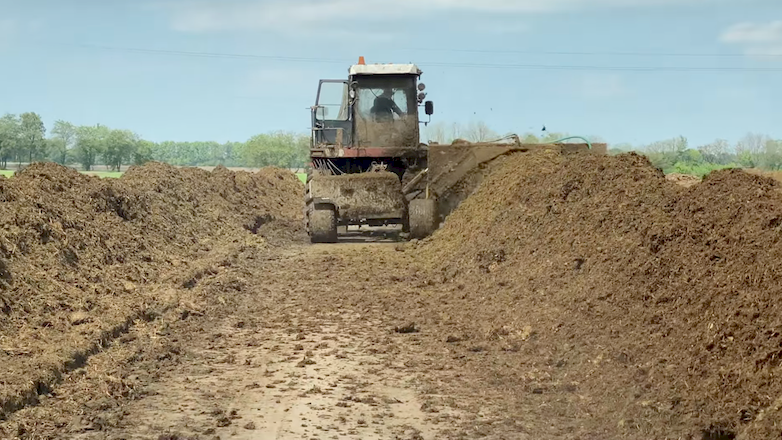
This matters especially on sandy plots like these. When soil contains little organic matter, everything that is returned can make a difference. Gradually, better conditions are created for retaining moisture, supporting plant growth, and sustaining soil life.
Compost, in this case, is not a “magic bullet.” Compost alone will not turn poor sandy soil into fertile soil in a single season.
This is a long-term process: returning organic matter, creating better conditions for soil life, and gradually restoring soil processes that had become severely limited. The results do not appear immediately. Perhaps that is why examples like this are so interesting. They do not show a polished picture after all the work has been completed. They show the work in progress.
During this visit, we talked a lot about no-till, seeders, costs, yields, and the farm’s search for an approach suited to its own conditions. Standing in the sandy field made the purpose behind all these decisions especially clear.
It is important to disturb the soil as little as possible. It is also important to preserve crop residues and moisture. But where the soil is already severely depleted, it may also be necessary to return what it lacks most: organic matter.
Perhaps that is why the story of the sandy field became a logical conclusion to our visit to Butenko Farm. The farm is not looking for a single universal solution. Different approaches are tested, the results are observed, and the pieces gradually come together into a system of its own.
Ultimately, all these decisions make sense only if they help the land become healthier.