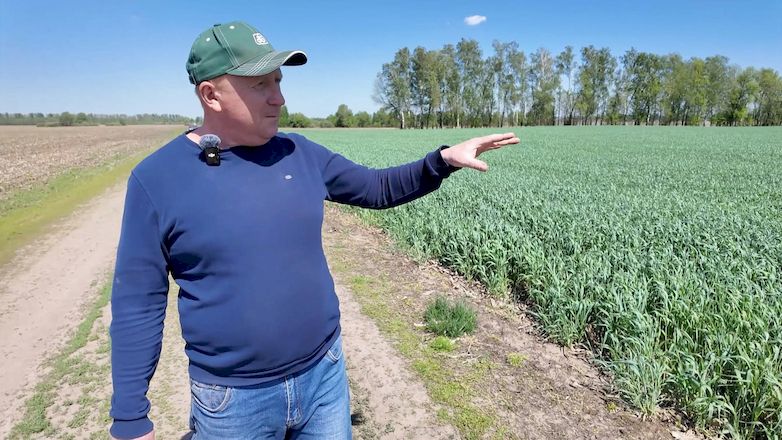
Roman Butenko and I first met in Kyiv at the ReAgro conference. In May, we met again, this time at Butenko Farm in the Chernihiv region.
We toured the livestock facilities, the composting site, and the fields. The farm has been using no-till on some fields for several years. On others, it is testing different approaches, comparing results, and gradually moving toward less soil disturbance.
What makes trips like this valuable to me is that they show not a polished, ready-made formula, but a real process of exploration.
A farm passed down through generations
Roman’s father started farming more than 30 years ago. He did not begin with a senior position or a large operation. He simply wanted to work the land.
Roman became part of this story as a child. He helped out, worked alongside his father, and watched the farm take shape not on paper, but in the fields, in the livestock buildings, and through daily work.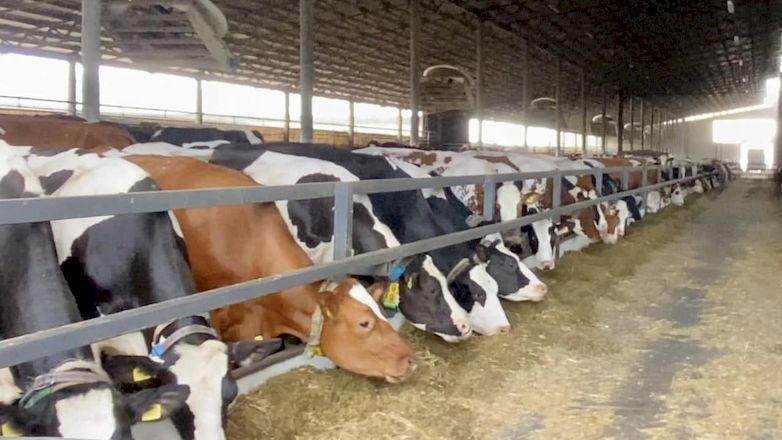 Livestock is one part of Butenko Farm’s operation.
Now he is carrying that work forward, with his own questions, his own vision, and his own search for a balance between crop production, livestock, profitability, and care for the land.
Yields have declined, but profits have not
The farm has been using no-till on one of its fields for several years. The corn had not yet emerged when we arrived, so we focused on what often goes unnoticed: crop residue, moisture, soil structure, earthworms, and compacted layers.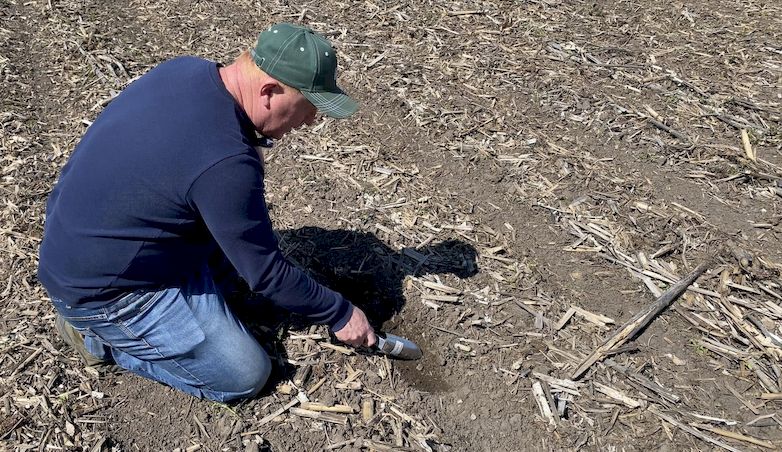 Roman Butenko examines the soil in a field that has been under no-till for several years.
Roman openly acknowledged that, at this stage, yields under no-till have been lower. But profits have not fallen because production costs have also come down.
This is an important detail. It is not enough to judge an approach solely by the yield from one field. We also need to consider costs, soil condition, and how a particular decision affects the economics of the entire farm.
Compare, rather than take something on faith
I was particularly interested in how the farm uses the “Kolisnytsia” implement.
First, we looked at a rye field planted with the “Kolisnytsia” after soybeans the previous autumn. The crop formed a continuous stand with no distinct rows, and the rye looked very good when we visited.
We then moved to a field where soybeans were being planted after corn. One part of the field was seeded with the “Kolisnytsia,” while the other was planted with a no-till precision planter.
What interests me most is the approach itself: not taking any one tool on faith, but testing, comparing, and seeing what works best under the farm’s own conditions.
“Spaceship”
The farm’s no-till planter did not begin as an expensive, ready-made solution either.
It started with a frame fitted with precision planting units. At first, the planter was used in a conventional tillage system. As the farm began moving toward no-till, it was gradually modified to meet new requirements.
Today, they jokingly call it the “spaceship.” When you see the number of sensors, monitoring systems, and custom features, it is easy to understand why.
But this story is not really about machinery. It is about a farmer’s ability to think, do the math, test, and adapt a solution to his own fields instead of expecting an expensive machine to solve every problem on its own.
How separate decisions become a system
Butenko Farm does not rely on one farming method for every situation. It uses no-till on some fields and different approaches on others. It also works with controlled-traffic lanes, agricultural drones, cover crops, and a crop rotation that is still being adapted to local conditions.
I find it more useful to look at farms like this not by asking whether everything is simply “right” or “wrong,” but by asking a different question: how do separate decisions gradually come together to form a coherent system?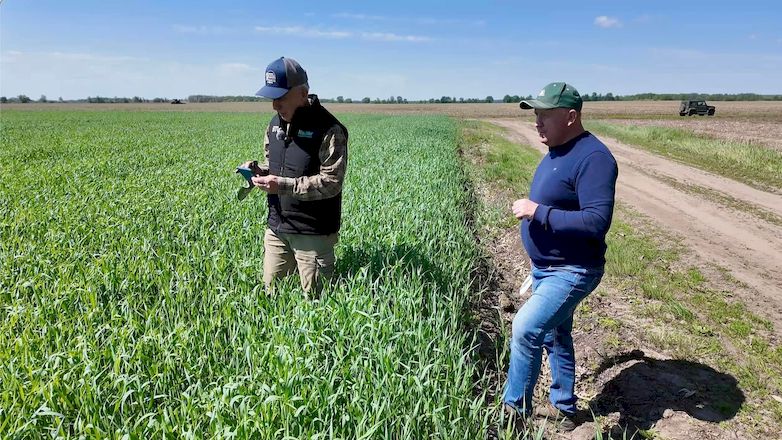 Touring the fields at Butenko Farm in the Chernihiv region.
Regenerative agriculture does not begin with an attractive label. It begins when a farmer takes a broader view of the farm: the soil, economics, machinery, moisture, risk, people, and its future.