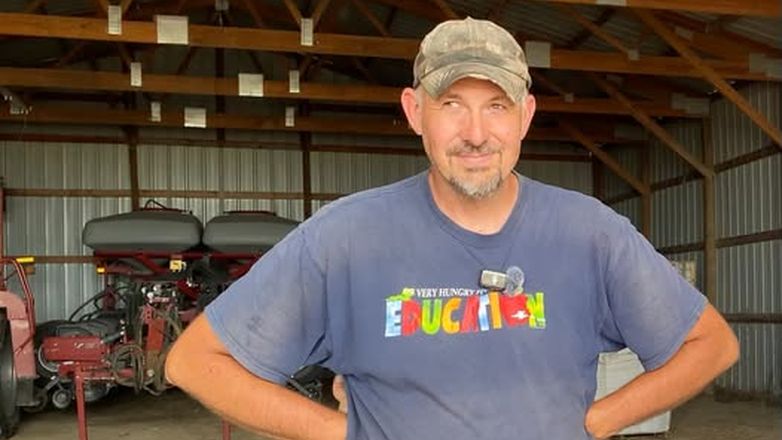
Our visit to Michael Thompson’s farm in Kansas began with a conversation in the machinery shed. We talked about the farm’s economics, equipment, and the principles Michael follows when making decisions. Only afterward did we head out to the fields and discuss his crop production practices in greater detail.
At first glance, these may seem like separate topics. But the same approach was evident throughout Michael’s answers. He does not stick rigidly to a predetermined plan. Instead, he considers the weather, available soil moisture, field conditions, and the economic sense behind each decision.
A crop plan shaped by the weather
A crop production plan usually sets out a clear sequence of operations: what to plant, how much fertilizer to apply, and when to carry out each operation.
On Michael’s farm, things work a little differently.
This part of Kansas has a dry climate, and rainfall can vary greatly from one year to the next. That means the crop plan cannot remain unchanged.
The nitrogen rate for corn depends on the amount of moisture available in the soil. If there has been enough rain and the field has good yield potential, Michael can continue applying nitrogen during the growing season. In a dry year, he reduces the rate because additional inputs may not produce a corresponding return.
He takes the same approach when choosing the next crop.
If there is enough moisture after harvest, he may seed wheat, rye, triticale, or a cover crop mixture. If moisture is lacking, Michael does not plant something simply because it was the next step in the original plan. Sometimes the better decision is to leave the field covered with crop residue.
At first, this may look like a departure from the plan. In reality, it is part of the plan: not forcing the field to do something it is not ready for.
Equipment that works
During the same conversation in the machinery shed, we also tried to understand the farm’s economics. We asked about income, major expenses, land, crop insurance, and equipment.
Of everything Michael said, one simple thought stayed with me:
“I need equipment that works. It doesn’t have to be the newest.”
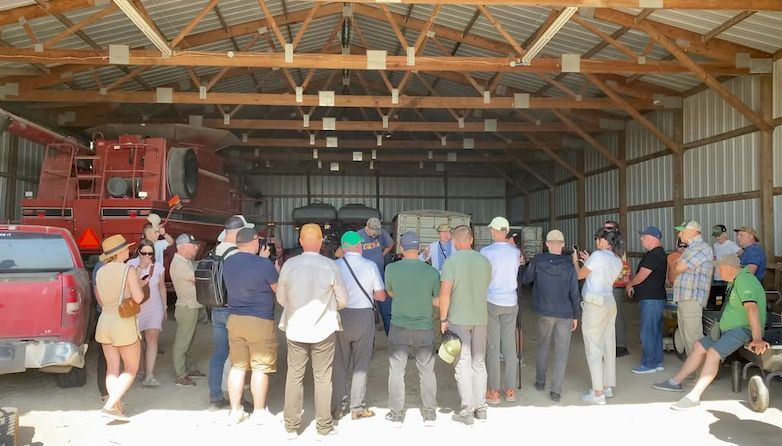
Over the years, the farm has roughly doubled in size. But buying the newest machinery was never Michael’s main goal. His priority was to organize field operations and build a farming system capable of working under unstable weather conditions.
That does not mean equipment is unimportant. A farm cannot function without it. But a new machine alone does not make the business more efficient, especially if a large share of the farm’s profit then has to be spent paying for it.
Michael sees equipment as a working tool. It must perform the necessary job when it needs to be done. Its model year or appearance does not always determine whether the farm will be profitable.
Decisions matter more than the plan
These two ideas may appear to concern different things. One is about weather and crop production. The other is about money and equipment.
Yet both come down to the same ability: not holding on to a decision simply because it was once written into the plan.
If there is not enough moisture, there is little sense in applying more fertilizer or planting the next crop merely to follow the plan. If the existing equipment is doing its job, there is no reason to replace it simply because a newer machine is available.
Perhaps this is how a farm becomes more resilient. Not through one “correct” crop plan or the most expensive machine. Resilience develops when a farmer assesses the actual conditions, considers the consequences, and remains willing to change a decision when necessary.
In these two videos, our conversation with Michael goes into much more detail. We discuss crop rotation, crop nutrition, cover crops, livestock grazing, expenses, insurance, and the farm’s sources of income.
But for me, the main takeaway is simple: the farming system must adapt to the field and the weather, while equipment should help the farm earn money rather than become an end in itself.