
We arrived at Michael Thompson’s farm in Kansas during a particularly dry period. It was immediately apparent: short corn plants, a dry soil surface, large amounts of crop residue, and moisture coming up constantly in conversation.
This area used to receive an average of about 22 inches of precipitation a year, or roughly 560 millimeters. By our standards, that is not particularly low. But according to Michael, rainfall has been declining in recent years, and the season of our visit was especially dry.
So I was interested in a very practical question: do cover crops use up moisture that is already in short supply for corn, soybeans, or wheat?
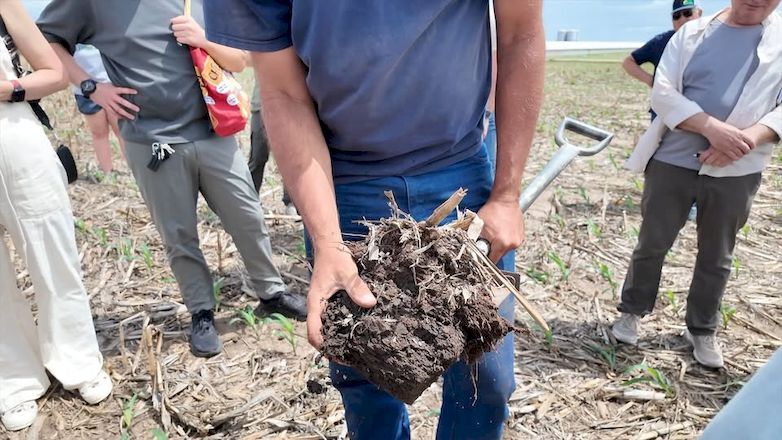
Can cover crops use up soil moisture?
Michael did not deny it. The risk is real.
This is particularly true at the beginning of the transition, when the soil is still compacted, roots cannot penetrate deeply, and most of the available water remains in the upper soil layer. Under these conditions, a cover crop can use some of the moisture needed by the following cash crop.
Over time, however, the situation changes.
Michael explained that cover crop roots gradually penetrate compacted layers and create channels through which water can move deeper into the soil. Soil structure improves, biological activity increases, and the roots of the following crop gain access to moisture they could not reach before.
In that sense, cover crops are partly an investment in the future. At first, they require particularly careful management. Over time, however, they can help the soil absorb more water and retain it for longer.
Not every crop is suitable for a dry year
Michael adjusts his choice of cover crops according to the amount of moisture available.
In a wetter year, he may use sorghum or sudangrass. These crops can produce large amounts of biomass and release plenty of root exudates during their early growth stages. The biomass can also be grazed by livestock.
But sorghum and sudangrass need enough water. In drier years, Michael prefers proso millet, which can produce biomass with less moisture. Sunflowers may also be included in the mixture.
When soil moisture is more plentiful, Michael tries to include around five species in the mix. Grasses usually make up a significant part of it. They decompose more slowly, protect the soil surface for longer, and develop fibrous root systems that create pathways for water to enter the soil.
There is no fixed recipe. The composition of the mixture depends on the conditions of that particular year, its place in the crop rotation, and the specific purpose it is meant to serve.
What happens after the corn harvest
After harvesting corn, the farm tries to sow rye or triticale. These crops can be planted later than oats or wheat.
Once again, however, the decision depends on moisture. If the autumn is too dry and there is not enough moisture for reliable germination, Michael does not sow a cover crop. The field remains protected by crop residue, and corn may be planted there again the following year.
On poorer fields that the farm has recently leased, rye or triticale may be allowed to grow longer and then grazed. Sometimes the farm gives up a cash crop for that season altogether, allowing more time for the soil to recover.
On fields that have been managed under this system for longer, the cover crop is terminated about two weeks before soybeans are planted.
This makes one thing clear: cover crops are not treated here as a compulsory operation performed according to a fixed schedule. Each time, Michael considers the available moisture, the condition of the field, and the task the cover crop is expected to perform.
A comparison with a neighboring field
The benefits of this approach became especially apparent when we compared Michael’s field with a neighboring farm.
Both farms use no-till. Michael, however, combines it with cover crops, a more diverse crop rotation, and livestock grazing.
In the neighboring field, the corn had emerged unevenly because of insufficient moisture. Emergence in Michael’s field was more uniform. He attributed this not simply to the absence of tillage, but to continuous soil cover, living roots, and greater biological activity in the soil.
We also compared soil from the two fields. The soil from Michael’s field was darker, had a better structure, and even smelled different.
The comparison showed quite clearly that no-till alone is not enough. Simply stopping tillage without adding plant diversity, living roots, and organic matter can produce a very different result.
The key is getting water into the soil
Michael gave us a simple comparison. According to him, around 30% of rainfall may run off a field without adequate soil cover. On a well-covered field, runoff may be closer to 5%.
In dry conditions, that difference is enormous. What matters is not only how much rain falls, but how much of that water the soil can actually absorb and retain.
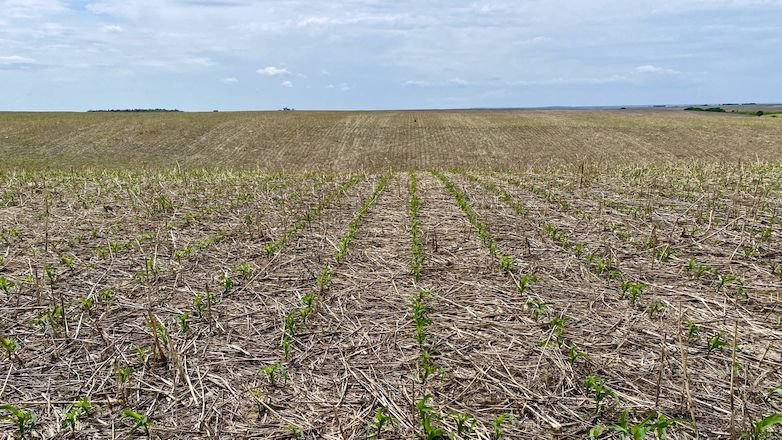
That is why the surface of Michael’s fields remains covered with crop residue. It protects the soil from the sun and wind, reduces evaporation, and slows runoff. Cover crop roots, meanwhile, create pathways that allow water to move deeper into the soil.
Standing in the field, Michael pointed out another simple detail. The soil beneath our feet did not feel hard like concrete. It felt more springy. He saw this as another result of roots and soil biology at work.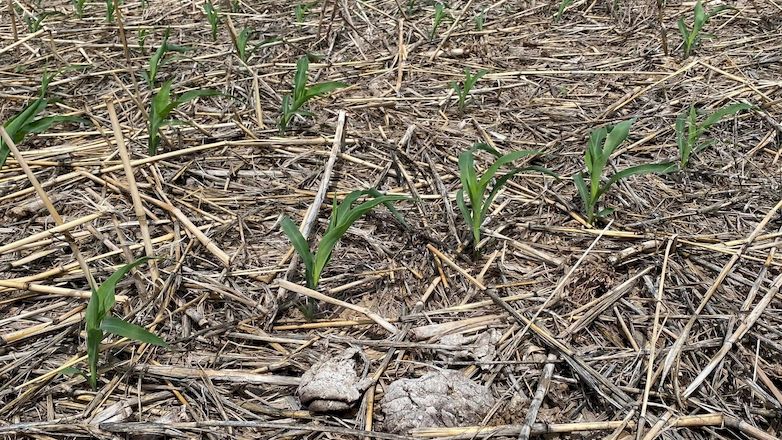
Cover crops are not a one-size-fits-all solution
After this conversation, I was once again convinced that the question “Do cover crops use up moisture?” does not have a simple answer.
They can use moisture if the wrong species is selected, if existing soil moisture is ignored, or if someone begins with compacted soil and expects immediate results.
With careful management, however, cover crops can help achieve something far more important: moving water into deeper soil layers and keeping it there for longer.
The difference becomes especially important during a dry season. This is no longer about having an attractive green mixture growing between cash crops. It is about whether the next crop will still have access to moisture after a long period without rain.
Michael’s experience shows that dry conditions do not necessarily mean giving up cover crops. They mean learning to select them according to the available moisture and understanding exactly what each mixture is expected to do in a particular field.